

Weight management

For 2026/27 there are two QoF indicators relating to obesity
OB004
- Patients with a BMI=>30 (or =>27.5 in certain minority ethnic backgrounds)
- Referred to a weight management programme within 90 days of BMI being recorded.
- Weight management programmes include:
- The national digital weight management
- The national diabetes prevention or path to remission programmes
- Local weight loss services- either tier 2 (local authority commissioned) or tier 3 services
- Upper Threshold of 30% of eligible patients. 5 points achievable.
- Large Denominator (About 10-15% of practice population)
OB005
- Percentage of eligible patients (as OB004) who have a recorded shared decision-making discussion about the management of obesity
- AND are offered NICE approved medicines management (pharmacotherapy) for use in a primary care setting
- WITH accompanying referral to suitable behavioural support programme (BSOP), in the preceding 12 months.
- Upper Threshold of 80%. 13 points achievable.
- Small Denominator Population
Better Health is a universal offer everywhere: Better Health – NHS
Lancashire County Council: Health programmes – Lancashire County Council
Blackburn: Refresh Blackburn with Darwen
Blackpool: Healthy Weight Blackpool | Public Health Blackpool Council
NHS Digital Weight Management Programme Healthcare Professional Toolkit
This includes:
- NHS Digital Weight Management Programme: at a glance
- Programme background
- Programme eligibility
- Referral process overview
- Accessibility of the NHS Digital Weight Management Programme
- Reaching eligible participants
- Promotional materials and literature
- Key messages
NHS Digital Weight Management Programme FAQs
E-Referral System Service Search- NHS Digital Weight Management Programme
A direct referral using the practice’s own e-RS system can be made by any member of the general practice healthcare team. This recognises the different relationships patients build with practice staff and ensures as many people as possible who may benefit from the NHS Digital Weight Management Programme are given the opportunity to participate.
The Digital Weight Management service is including in the Enhanced Service Specification (Weight Management), so the GP will get £11.50 per referral.
NHS Digital Weight Management Programme
SNOMED code is 1402911000000108
Referral to National Health Service Digital Weight Management Programme (procedure)
Additional information is available on the NHS Futures DWMP page, which anyone can request access to.
Semahealth has been confirmed as the accredited provider for all specialist weight management services (SWMS) across Lancashire and South Cumbria, for Tier Three services, engaging patients on a very low calorie diet. The referral form is on EMIS.
Referral criteria for SWMS:
- BMI ≥ 50 kg/m
OR
- BMI ≥ 40 kg/m² with at least 1 major obesity-related condition
- Recent screening (i.e. within the last 3 months) to include a measure of blood pressure (BP), heart rate and the following blood tests: TSH, HBA1C, Lipid Profile, Liver Function tests including ALT.
- One of the below comorbidities:
- Type 2 diabetes
- Obstructive sleep apnoea
- Severe hypertension on ≥ 2 agents
- Idiopathic intracranial HTN
- NAFLD/NASH
- Severe osteoarthritis of the spine, hips or knees – awaiting surgery
- Weight-related infertility or PCOS – awaiting fertility treatment
- Established atherosclerotic CVD (history of MI, CVA, TIA, IHD or PVD)
- Heart failure where obesity is a significant contributing factor.
- Requiring life prolonging surgery / intervention that can only take place at a lower BMI.
Practices can prescribe tirzepatide to patients who meet the criteria set out in the NHS England Funding Variation. The Funding Variation will see the eligibility of patients able to access tirzepatide via their GP expand over a 12 year timescale.
At present prescribing is available for Cohort 1- those with a body mass index (BMI) of 40 kg/m² or more (or 37.5 kg/m² for people from minority ethnic family backgrounds) who are at least 18 years old and have at least four of the following long-term conditions:
- Atherosclerotic cardiovascular disease (ASCVD)
- Hypertension
- Dyslipidaemia
- Obstructive sleep apnoea
- Type two diabetes mellitus
From 23 June 2026 cohort 2 will open and the required BMI will reduce to 35, or 32.5 for those from a minority ethnic family background.
Anyone prescribed with tirzepatide must also be referred to, and engage with, the Healthier You: Behavioural Support for Obesity Prescribing (BSOP) Programme aka wrap around care. The referral form has been uploaded to your EMIS system.
It is recognised that is exceptional cases a patient may be eligible for a tirzepatide prescribing in primary care but their complexity of needs mean they need an individualised MDT approach to their wrap around care. In these cases, a patient can be referred to Semapen for wrap around care and prescribing.
A webinar was held on the 3 June 2026 to explain the changes:
If there are no local authority tier 2 services how can we achieve OB004?
Patients can be referred to the national digital weight management, the national diabetes prevention or path to remission programmes as appropriate.
If a patient does not meet the referral criteria patients can be marked as exempt under the QoF business rules, and support is available via Better Health on the NHS website (tier one service).
If a patient has commenced a GLP-1 privately can they transfer to NHS treatment?
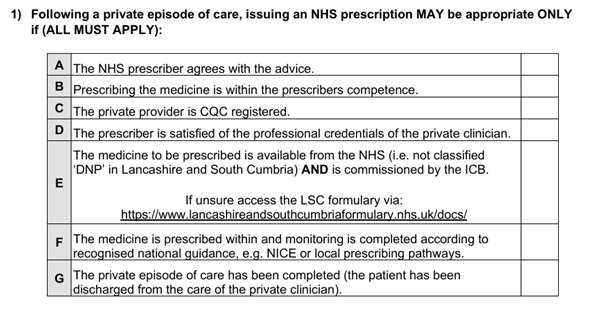
Please refer to the section on private prescribing within the Good prescribing in primary care December 2025 update.pdf document on NetFormulary for further information.
The patient should meet the current cohort requirements when transferred, based on current BMI and co-morbidities.
Can we refer to a SWMS provider other than Semapen/health?
- There are a number of providers that hold qualifying contracts with other ICBs across the country
- Under Right to Choose a patient maybe referred to another SWMS provider in the following circumstances:
- A referral is clinically appropriate
- The patient meets the local policy
- A choice conversation takes place
- Note only accredited providers have undergone an assurance policy with the ICB
Does a patient need to have engaged in tier 2 or other services before being prescribed tirzepatide?
No, a patient may be prescribed tirzepatide if they are in an open cohort as articulated in the NHS England Funding Variation which based on BMI and co-morbidities.
If a patient meeting the tirzepatide criteria but cannot tolerate/it is contraindicated can an alternative be prescribed?
In these cases the patient should be referred to the tier three service who can offer a VLCD or an alternative GLP-1.